
Aug 6 – 30, 2024
The Witches’ Twine
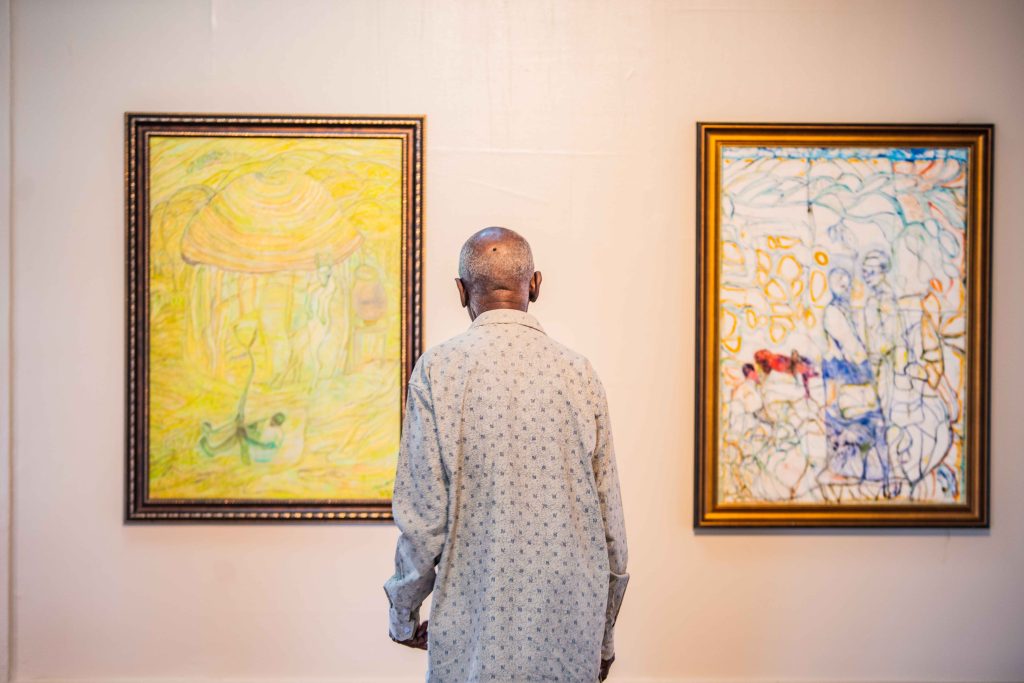
Like a patient weaver, time has painstakingly and slowly spun its intricate web around the figure “Buluma Ochungo Mordecai”, the artist whom the exhibition, Buluma: Amakowola! The Return celebrates. In this exhibition, the ninety-year-old Buluma emerges like the proverbial cat with nine lives; he played his role as an artist, strayed into temporal oblivion, but returned after seventeen years (2004-2021) to show a body of works that has reincarnated him as an artist given a fresh chance to pursue his passion and to fulfil his dreams and destiny. His return is a testament to the enduring human spirit, and the new works on display are deeply entwined with the essence of an artist’s life force and source.
To explore Buluma’s life and work, we invoke the West African trope of “The Witches’ Twine,” the unseen thread binding the living to the ancestors and spirits. Buluma’s art, like this twine, weaves a seamless connection between past, present, and future, forming a living, breathing body of work. His gesture aligns him, not distantly, with West African literary figures like John Pepper Clark, Amos Tutuola, Wole Soyinka, and Ben Okri, who navigated the liminal spaces between worlds through the haunting figure of the Abiku, the child fated to die and eternally returns. Yet, Buluma forges his unique path, transforming the oral lore of Eastern Uganda into a unique corpus of visual poetry. Here, his canvas becomes a portal, inviting viewers to cross the threshold between the mundane and the mystical, the social and the mythic.
Buluma is an avid writer and storyteller. He grounds much of his work in the rich soil of folklore. Drawing inspiration from local and urban myths, he brings to life the traits of animals through his graphite drawings on paper, some of which he later transforms into vivid oil paintings on canvas. Through his art, Buluma breathes life into the heritage of Eastern Uganda, capturing the essence of legends and tales, with a particular fascination for caricatured animal characters. His work reimagines traditional sayings and stories, once passed down orally, in a visual form that resonates with insights and ethical values of ordinary people in and out of his kin.
Buluma’s paintings are rich with proverbs and anecdotes, serving as a reservoir of archetypes that forge universal communication codes. In doing so, he attempts to bridge the gap between the spoken and written forms of the African languages Samia-Lugwe and Swahili languages respectively. Through his work, Buluma has significantly enriched the tradition of Samia-Bugwe tales, blending words and phrases shaped by print and film culture. His journeys as an artist, his experiences as an art teacher, and his role as a cultural troupe director during the 60s and 80s have all contributed to this vibrant exchange of ideas. Proverbial wisdom, employed in various social contexts like commentary, education, and entertainment, finds new life in his art, reflecting how individuals and ethnic groups use these age-old insights.
Proverbs are the distilled wisdom of ages that have been crystallised into bite-sized nuggets of truth. By employing them, Buluma’s paintings bear the echoes of ancestral voices, reverberating through time, carrying the weight of collective human experience. Like shadows, they shift and change with each retelling, losing pieces of themselves in translation. Jacques Rancière talks about how power shapes what we can see as art, and how it can tie art strictly to the despot’s version of morality, religion, and social order. Buluma knows this game, but he does not play by the rules. He turns these old stories inside out, puts animals in the place of people, and laughs at the fear and anger that usually seep through the cracks of such tales. He paints with airy strokes and pastel palettes that charm many viewers, but he also sets his characters in scenes framed by fictional and fantastical landscapes. Other works depict animals like goats and humans in lighthearted moments, courtship scenes, dance parties, and community gatherings or performances.
Various local fables explore the duality of living between two worlds—featuring animals, plants, or anthropomorphized natural forces. Buluma explores these propensities by weathering the storms of time, emerging like a seasoned hunter from the forest. His seventeen-year absence from the art scene might have been a long night, but dawn has broken, and with it, a fresh harvest of art. Needless to say, these new works are not mere paintings, but windows into a soul rejuvenated – perhaps, carrying the promise of an eternal return like an Abiku.
By Nantume Violet

Buluma Ochungo Mordecai, 2021.
Artist’s Biography
Buluma Ochungo Mordecai is a key figure in Ugandan modernism. Born in Samia-Bugwe, Uganda, Buluma’s artistic training began at Budo King’s College. He was also trained at Makerere Art School under the Scottish artist and art teacher Cecil Todd at the time he was “revising” Margaret Trowell’s curriculum. He studied painting with Margaret Trowell, sculpture with Gregory Maloba, and drawing with Cecil Todd. After Makerere, Buluma furthered his art training at Mount Allison University in Canada.
Exhibition Production Team: Adviser: Buluma Ochungo Mordecai; Curator: Nantume Violet; Curatorial Assistants: Mugeni Jackline and MF Semuju; Translation by: Peter Kalisti Hakwa; Production by: Barbra Mirembe Nafula, Mugeni Jackline, MF Semuju, and Zitoni Tristan Kayonga Tani; Electricians Ogiya Daniel and Wankusi Paul; Painters Kyolya Kenneth, Mukwa Deo, Olumu George, and Sifuna Francis; Plumber: Mugeni Ivan; Installation by: MF Semuju and Zitoni Tristan Kayonga Tani; Installation Assistants: Gonza Philip, Mukada David, and Olagwa James; Photography: Julia Gyemant and Wanyama Robert; and Graphic Designers: Kikomeko Gerald Puto and Wasswa James.
0 comments on “BULUMA AMAKOWOLA! (The Return)”